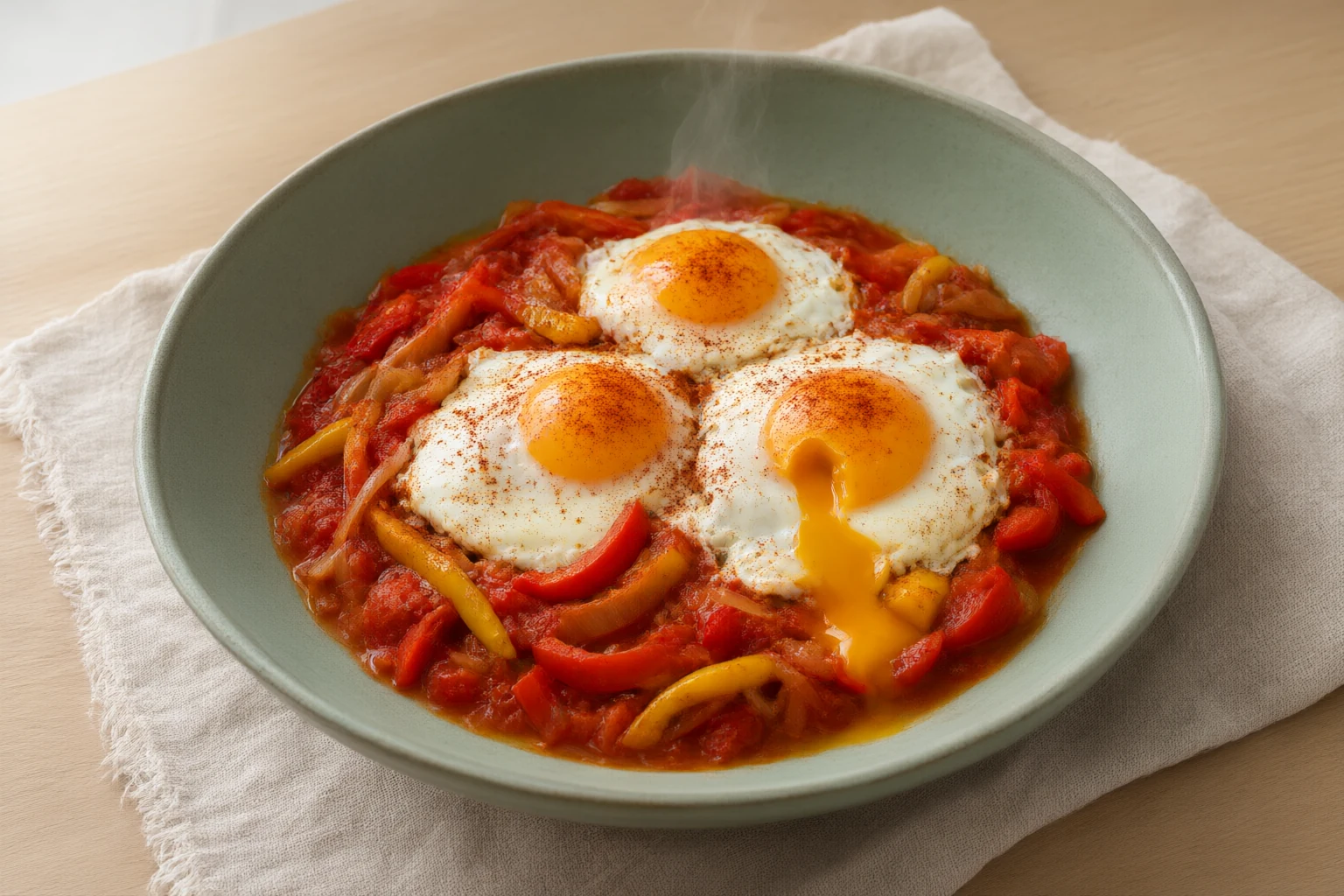
TL;DR
- 440 kcal · 17.5 g protein per serving
- Ready in 50 min · serves 2
- Vegetarian, Gluten-free, Dairy-free, High fibre
Lecsó is the taste of Hungarian summer. When the markets overflow with glossy peppers and heavy, sun-warmed tomatoes, this is what gets cooked in nearly every household from Budapest to the Balaton. It's not a fancy dish — it's a humble, rustic stew of peppers, tomatoes, and onions, slowly simmered until the vegetables collapse into a sweet, savory, almost jammy sauce. The version here, with eggs gently baked into the mixture, is a classic lunch or light supper, often served with fresh white bread for soaking up every last drop.
Lecsó's roots are in the vegetable gardens of rural Hungary, where the summer harvest had to be used up quickly. It's a cousin to the Serbian đuveč and the Turkish menemen, but the Hungarian version is distinct: it's not a side dish, it's the main event. The eggs are a natural addition — they add richness and turn the vegetable stew into a complete, satisfying meal. This is peasant food at its best, and its beauty lies in its simplicity and the quality of its few ingredients.
For anyone tracking calories, this lecsó is a dream. It's naturally low in fat and packed with vegetables, so you get a large, filling portion for a modest number of calories. The peppers and tomatoes provide a good amount of fiber, which keeps you feeling full and satisfied. The eggs add high-quality protein, making this a balanced meal that won't leave you hungry an hour later. Because the dish is so vegetable-forward, you can easily control your portion size — a generous bowl is still a reasonable meal, and you can adjust the number of eggs per serving to suit your protein needs.
A few tips for getting it right: First, don't rush the onions. Cooking them slowly in the oil until they're soft and translucent — not browned — is the foundation of the dish's sweetness. Second, the type of pepper matters. The classic Hungarian lecsó uses a pale, yellow-green pepper called tv paprika, which is sweet and thin-walled. If you can't find it, a mix of regular green bell pepper and a slightly sweeter variety like a red bell or a Cubanelle works beautifully. Avoid using all spicy peppers unless you want a fiery version. Finally, the eggs should be added at the very end, and the pan should be taken off the heat while the yolks are still slightly runny — they'll continue to cook in the residual heat. This gives you a luxurious, creamy sauce when you stir them in.
Ingredients — For 2 servings
- 3 tbsp olive oil (or sunflower oil) 40 g
- 1 large onion, thinly sliced (about 1 large) 150 g
- 2 medium green bell pepper, cut into strips (about 2 medium) 240 g
- 1 medium red bell pepper, cut into strips (for sweetness and color) 120 g
- 4 medium ripe tomatoes, chopped (about 4 medium, or 1 can (400g) of crushed tomatoes) 500 g
- 1 tsp sweet Hungarian paprika (use a good quality one) 3 g
- 0.5 tsp fine salt (to taste) 3 g
- 0.25 tsp black pepper, freshly ground (to taste) 1 g
- 4 large eggs (2 per serving) 200 g
Nutrition per serving
440 kcal
| Protein | 17.5 g |
|---|---|
| Carbohydrates | 27.8 g |
| of which sugars | 15.7 g |
| Fat | 30.7 g |
| of which saturates | 6.1 g |
| Fiber | 8.2 g |
| Sodium | 746 mg |
Nutrition computed from USDA FoodData Central per-ingredient data (curated reference table, engine/systems/recipe/data/ingredient_nutrition_db.json). 5 of 9 ingredients use a model-estimated figure pending live FDC verification (flagged in the source table).
Instructions
-
Heat the olive oil in a large, deep skillet or Dutch oven over medium heat. Add the sliced onion and a pinch of salt. Cook, stirring occasionally, until the onion is soft and translucent, about 5-7 minutes. Do not let it brown.
~7 min -
Add the sliced green and red bell peppers to the pan. Cook for another 5-7 minutes, stirring now and then, until the peppers have started to soften and release some of their liquid.
~7 min -
Sprinkle the sweet Hungarian paprika over the vegetables and stir well to coat. Cook for just 30 seconds, stirring constantly, to toast the paprika and release its flavor. Be careful not to burn it, as it will turn bitter.
~1 min -
Add the chopped tomatoes to the pan. Stir everything together, scraping up any browned bits from the bottom of the pan. Bring the mixture to a gentle simmer.
~2 min -
Reduce the heat to low, cover the pan, and let the lecsó simmer gently for 15-20 minutes. The vegetables should be very soft and the mixture should have thickened into a rich, saucy stew. Stir occasionally to prevent sticking. Season with salt and black pepper to taste.
~20 min -
Taste the lecsó and adjust the seasoning. It should be sweet and savory, with a slight tang from the tomatoes. If it seems too thick, add a splash of water. If it's too watery, simmer uncovered for a few more minutes.
-
Using the back of a spoon, make 4 small wells or indentations in the surface of the lecsó. Carefully crack one egg into each well. Season the eggs with a tiny pinch of salt and pepper.
~2 min -
Cover the pan and cook over low heat for 5-8 minutes, until the egg whites are set but the yolks are still soft and runny. The exact time will depend on your stove and pan. Remove the pan from the heat immediately.
~8 min -
Let the lecsó rest for 2-3 minutes. Serve directly from the pan, spooning the vegetables and an egg onto each plate. A slice of crusty bread is essential for soaking up the delicious sauce.
~3 min
Track Lecsó with Eggs (Lecsós Tojás) in Kaloria
No manual logging — point your camera at the plate and Kaloria's AI recognizes the dish and logs it with the nutrition panel above in one tap. Voice logging and a food-savvy AI coach are built in too.
Get Kaloria freeFrequently asked questions
Can I use canned tomatoes instead of fresh?
Absolutely. In the winter, or when good fresh tomatoes aren't available, a 400g can of crushed or whole peeled tomatoes is a perfect substitute. If using whole peeled tomatoes, just crush them with your hands before adding. You may need to simmer the lecsó a little longer to thicken it, as canned tomatoes often have more liquid.
What kind of peppers should I use?
The classic Hungarian lecsó uses sweet, pale yellow-green peppers. In most places, a combination of green and red bell peppers works wonderfully. For a slightly more authentic flavor, try adding a mild banana pepper or a Cubanelle. If you want some heat, you can include one small spicy pepper, but remove the seeds and ribs to control the spice level.
How do I store and reheat leftovers?
Lecsó with eggs keeps well in the refrigerator for up to 3 days in an airtight container. The eggs will firm up, which is fine. To reheat, gently warm it in a skillet over low heat, stirring occasionally, until heated through. The flavors actually meld and improve overnight. It's not recommended to freeze, as the texture of the peppers and eggs will become mushy.
Can I make this vegan?
Yes, easily. Simply omit the eggs entirely. The vegetable stew itself is already vegan. You can serve it as a hearty main dish with some crusty bread, or as a side to grilled meats or sausages. To make it a more substantial vegan meal, you could stir in some cooked white beans or chickpeas at the end.
Why are my eggs runny or overcooked?
The key is low heat and watching closely. The eggs should be added to the hot lecsó, but the pan should be on the lowest heat setting. The whites need to set, but the yolks should remain soft. Start checking after 5 minutes. If the whites are still translucent, give it another minute or two. Remember, they'll continue to cook from the residual heat after you take the pan off the stove.
Sources
- USDA FoodData Central — Nutrition panel computed from USDA FoodData Central per-ingredient data via a curated reference table.