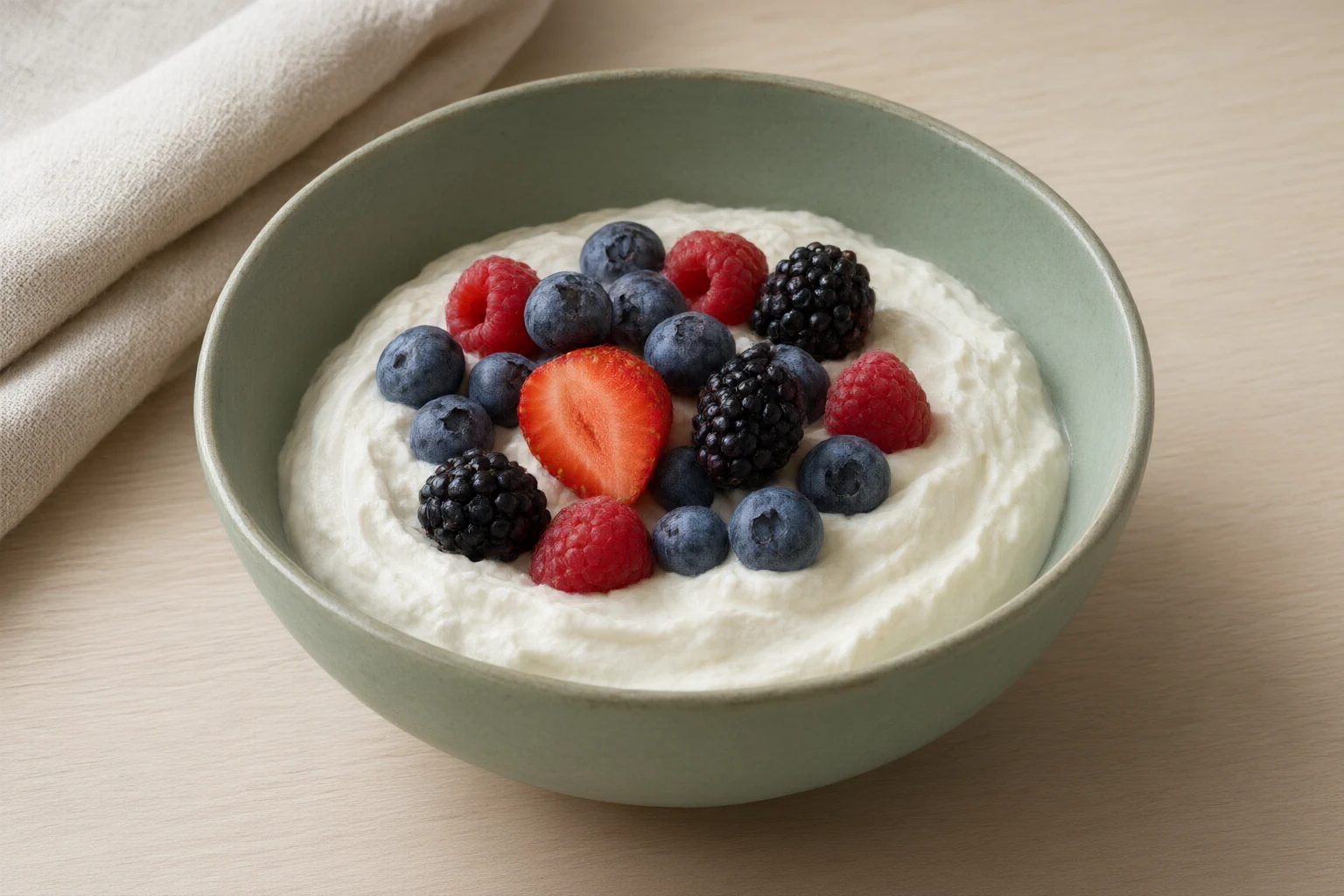
- Per portion
- 192 kcal
- Protein
- 20.49 g
- Carbs
- 19.47 g
- Fat
- 4.1 g
- Fibre
- 1.92 g
Your portion
- Protein
- 20.49 g
- Carbs
- 19.47 g
- Fat
- 4.1 g
This bowl is mostly water, at over 80 percent, which is why it feels light. Its real character is protein, delivering nearly 20 grams per serving and making up 55 percent of its calories. It also stands out for selenium, covering 23 percent of the daily reference, plus meaningful amounts of vitamin B12 and phosphorus, each around a fifth of daily needs. Carbohydrates are modest at under 8 grams, almost entirely from natural sugars.
A normal portion is a single 200-gram bowl, which works well as a satisfying breakfast or post-training snack on its own. Since it has no fiber, adding the berries brings some, and you could round it out with nuts or seeds for extra texture and healthy fats. The honest caveat is that the protein is high but the calorie count is low, so if you need more energy, you will want to pair it with something substantial rather than expect this alone to carry a heavy meal.
Nutrition claims, per 100 g:
How to put it together
- Spoon the yogurt into a bowl.
- Top with the berries and serve.
Full nutrition
Nutrition
per 1 bowl (280 g)
| Energy | 204 kcal | 10.2% |
|---|---|---|
| Energy | 854 kJ | 10.2% |
| Protein | 27.86 g | 55.7% |
| Carbohydrates | 11.03 g | 4.2% |
| of which sugars | 9.97 g | 11.1% |
| Starch | 0.0 g | |
| Fibre | 0.0 g | |
| Fat | 5.38 g | 7.7% |
| of which saturates | 3.44 g | 17.2% |
| Monounsaturated | 1.36 g | |
| Polyunsaturated | 0.21 g | |
| Trans fat | 0.17 g | |
| Cholesterol | 28.0 mg | |
| Water | 233.97 g | |
| Ash | 1.76 g |
Sugar breakdown
Minerals
Vitamins
Fatty acids
Amino acids
Nutrition from USDA FoodData Central (public domain), scaled to the stated portion. Reference intakes: EU Regulation 1169/2011. Percentages track your portion; claim badges are per 100 g (Reg. 1169/2011, 1924/2006).
How it compares
Against 322 other foods in “Dairy and Egg Products”, per 100 g. The mark is this food; the faint line is the category median.
Common portions
- container (7 oz) — 200 g (146 kcal)
Sources
- USDA FoodData Central — Yogurt, Greek, plain, lowfat — Nutrition values for Yogurt, Greek, plain, lowfat.