
#What Katch-McArdle Actually Measures (That Mifflin-St Jeor Doesn't)
Mifflin-St Jeor estimates resting metabolic rate from sex, age, height, and total body weight — it treats a kilogram of muscle and a kilogram of fat as identical inputs. Katch-McArdle throws out total weight entirely and calculates BMR directly from lean body mass: BMR = 370 + (21.6 × LBM in kg), where LBM = weight × (1 − body fat%/100).
That's the single variable that separates them. Mifflin-St Jeor asks "how much do you weigh." Katch-McArdle asks "how much of that weight is metabolically active tissue."
For most people the two formulas land within a rounding error of each other, because body composition doesn't vary that much across the general population. For gym-goers and recomposition users who've measured their body fat, the gap can be large. In the worked example below — 100kg, 15% body fat — the BMR estimates differ by more than 260 kcal, and that gap widens further once an activity multiplier is applied.
Rule of thumb: if you don't know your body-fat %, don't force Katch-McArdle. A guessed input creates false precision, not accuracy.
#The Mechanism: Why Muscle Tissue Burns More at Rest Than Fat Tissue
Lean mass — muscle, organs, bone — is metabolically active tissue that burns roughly 10 to 15 kcal per kilogram per day at rest, versus about 4.5 kcal/kg/day for fat tissue. That two-to-threefold difference is why two people who weigh exactly the same can have meaningfully different resting metabolisms.
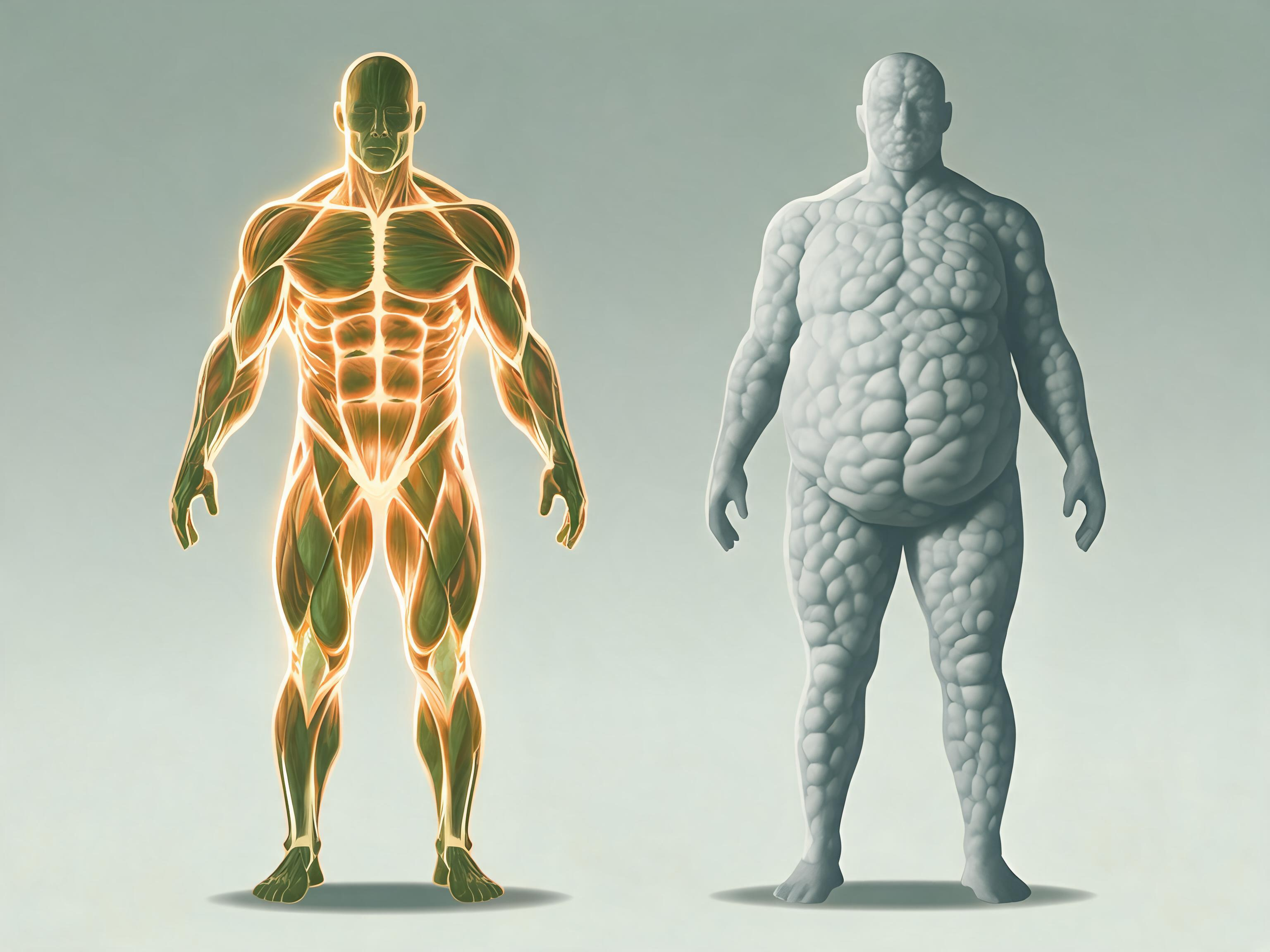
Picture two people, both 100kg. One is at 15% body fat, carrying 85kg of lean mass. The other is at 30% body fat, carrying 70kg of lean mass. Same scale weight, same height input into Mifflin-St Jeor — but the first person is hauling around 15 extra kilograms of tissue that's burning calories around the clock, while the second is carrying that same 15kg as fat, which is comparatively inert. In a population where about 20% body fat is typical, muscle contributes roughly 20% of total daily energy expenditure while fat contributes only about 5% — a striking asymmetry given how much fat mass often outweighs muscle mass on a scale.
#Where Intuition Fails: Same Weight, Same Height, Same Age — Different Number
Mifflin-St Jeor can't see body composition, so it gives identical BMR estimates to two people who are, physiologically, quite different. That's the systematic blind spot recomp users run into.
| Input | Person A | Person B |
|---|---|---|
| Weight / height / age | 100kg / 178cm / 35 | 100kg / 178cm / 35 |
| Body fat % | 15% | 30% |
| Lean mass | 85kg | 70kg |
| Mifflin-St Jeor BMR | 1,942 kcal | 1,942 kcal |
| Katch-McArdle BMR | 2,206 kcal | 1,882 kcal |
Mifflin-St Jeor hands both people the exact same number, because weight is the only body-composition proxy it has. Katch-McArdle separates them by 324 kcal — a difference big enough to change whether a "maintenance" calorie target is actually a slow bulk or a slow cut. This is the core case for the lean-mass correction: it exists specifically for situations where weight alone stops being an honest predictor.
#Worked Example: A 200+ kcal Gap for a 100kg Lifter at 15% Body Fat
Take a real case: a 35-year-old man, 178cm, 100kg, measured at 15% body fat, training four times a week (activity multiplier 1.55).
Mifflin-St Jeor BMR: 10×100 + 6.25×178 − 5×35 + 5 = 1,942.5 kcal Katch-McArdle: lean mass = 100 × 0.85 = 85kg → BMR = 370 + 21.6×85 = 2,206 kcal
That's a 263.5 kcal gap at the BMR stage alone, before any activity multiplier is applied.
| Formula | BMR | × 1.55 activity | TDEE |
|---|---|---|---|
| Mifflin-St Jeor | 1,942.5 | 3,010.9 kcal | |
| Katch-McArdle | 2,206.0 | 3,419.3 kcal |
The activity multiplier doesn't just preserve the gap — it amplifies it, to roughly 408 kcal/day. Over a week that's close to 2,860 kcal, the equivalent of an extra full day of eating. Over a month of a recomposition plan, that's the difference between a target that keeps this lifter roughly at maintenance and one that quietly under-fuels him into a deficit steep enough to cost muscle along with fat. This is exactly the profile — highly trained, low body-fat — where a 2026 preprint reported Katch-McArdle showing the closest correlation with measured energy expenditure (r ≈ 0.98) among the formulas it tested. That paper hasn't yet been through peer review, so treat the specific correlation figure as preliminary rather than settled — but it's directionally consistent with why a lean-mass correction exists in the first place.
#The 3 Edge Cases Where Katch-McArdle Backfires
The lean-mass correction is only as good as the body-fat number feeding it. Three situations turn that dependency into a liability.
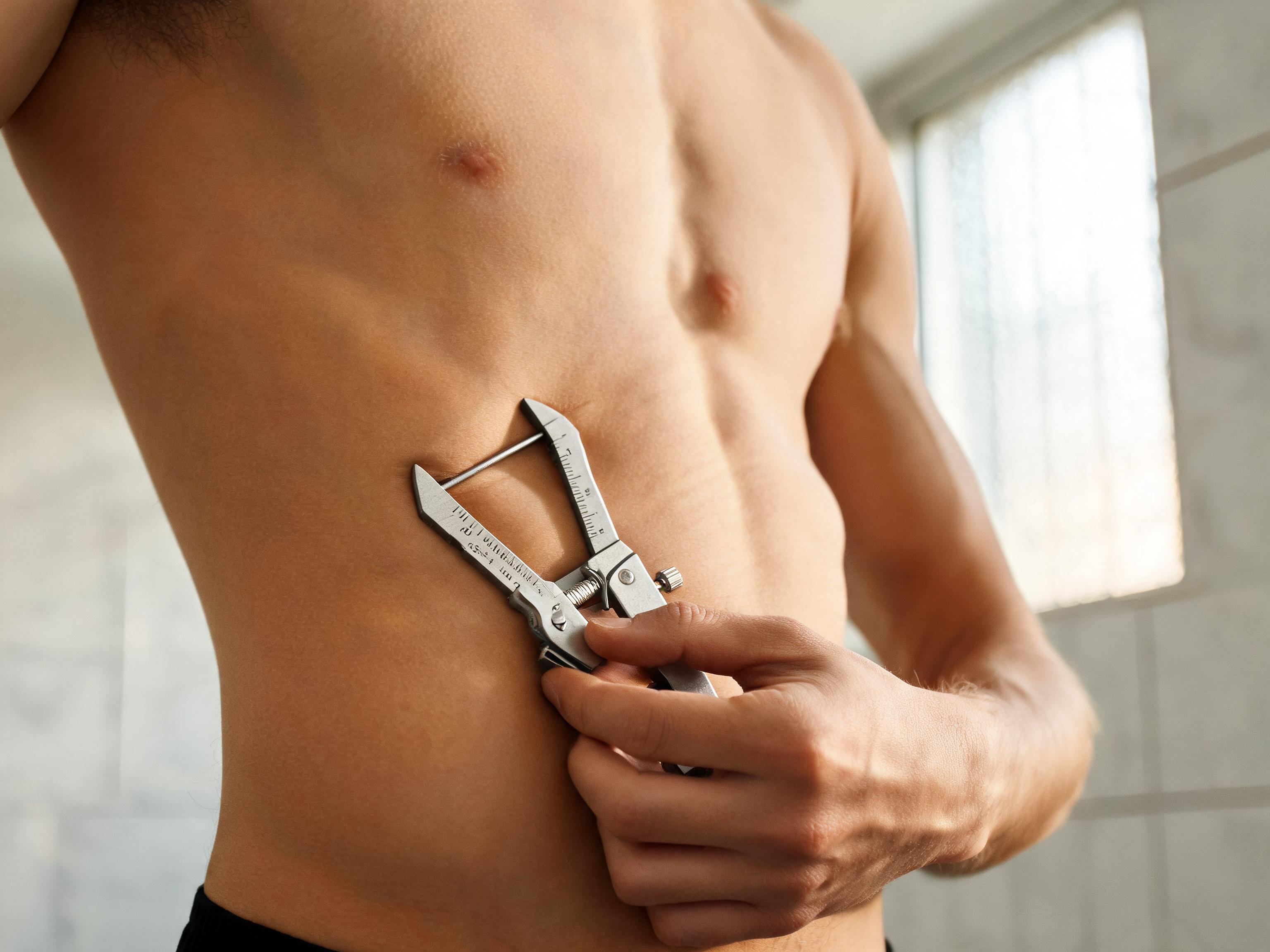
1. Very lean users. Circumference-based methods like the Navy tape method have their largest absolute error at the extremes — under roughly 8% body fat in men or 15% in women, small measurement mistakes translate into large lean-mass swings, which Katch-McArdle then bakes directly into the BMR estimate. Body-fat accuracy is the single biggest sensitivity in the Katch-McArdle calculation, and that sensitivity is likely worst exactly where visual and tape-based body-fat estimation is hardest to nail down — a reasonable inference from the pattern, though not something the source itself measures directly.
2. Older adults. The formula's 21.6 kcal-per-kg-of-lean-mass constant assumes lean tissue behaves consistently across ages. Sarcopenia changes the composition and metabolic activity of "lean mass" itself as people age, and there's no well-validated age adjustment built into Katch-McArdle to correct for it — Mifflin-St Jeor's age term, by contrast, is derived directly from the population it was validated on.
3. Guessed or outdated body-fat inputs. A body-fat % from six months ago, or one eyeballed rather than measured, produces a Katch-McArdle number that looks more precise than Mifflin-St Jeor's — more decimal places, a formula name that sounds more scientific — while actually carrying more error. A confidently wrong number is worse than an honestly approximate one.
#Which Formula Should You Actually Use?
Use Katch-McArdle if you have a recent, reasonably reliable body-fat measurement and sit below roughly 20% body fat — this is where Mifflin-St Jeor tends to systematically under-predict for muscular builds. Use Mifflin-St Jeor as the default otherwise: it's the most validated weight-based equation we have, and it doesn't need an input you might be getting wrong.
If you're not sure which camp you're in, run both. The calculator below computes Mifflin-St Jeor and Katch-McArdle side by side from the same inputs, shows the exact kcal gap, and flags if your numbers fall into one of the three edge cases above — very lean, over 65, or missing a body-fat input entirely.
#What the Data Shows: Recomp Calculators Are a High-Intent Niche
Across aggregated, anonymized usage data from Kaloria's free calculators (May–July 2026), 67,613 calculations ran across 1,361 tool pages. Body-recomposition wasn't the biggest tool by volume — the German version logged 490 calculations in that window — but it's one of the sharpest performers in search.
That CTR matters because of context: after Google's May 2026 core update, site-wide impressions dropped 91% and clicks dropped 80%, while average position actually improved from 9 to 4.9. The pages that survived weren't commodity converters — those lost the most ground — they were the complex, personalized calculators people search for by name because a generic number doesn't answer their question. Recomp calculators fit that pattern: someone who's measured their body fat and wants a formula that uses it may not be looking for a one-size-fits-all TDEE.
We treat that as a signal, not proof — 490 calculations is a modest sample, and calculator users are self-selecting for people who already suspect a single generic number won't fit them. It's consistent, though, with why every calculator on kaloria.ai ships with build-time test cases rather than a single hardcoded formula: the honest answer to "what should my calories be" is often "it depends on which number you trust and why."

Once you've got a calorie target you trust, the harder part is hitting your protein and calories daily without manually logging everything. Kaloria's AI scanner reads a photo of your plate and estimates the macros — two free scans a day, no card required.
How often should I recalculate my Katch-McArdle number as my body composition changes?
Whenever you re-measure body fat — most recomp plans warrant a re-check every 4-8 weeks. Recalculating on stale body-fat data defeats the purpose of using Katch-McArdle in the first place; you're better off with Mifflin-St Jeor until you have a fresh number.
Is Katch-McArdle more accurate than Mifflin-St Jeor for pure weight loss, not just recomposition?
Only if you know your body fat % and it's under roughly 20%. For general weight loss without a body-fat measurement, Mifflin-St Jeor remains the more validated default: a 2005 systematic review found it predicted RMR within ±10% of measured values in more nonobese and obese individuals than any other equation tested, and a separate 2013 validation study found it hit that same ±10% mark for about 82% of nonobese adults specifically. Those are two different studies with two different findings — but both point the same direction.
Which body-fat measurement method (calipers, Navy tape, DEXA, smart scale) is reliable enough to feed into Katch-McArdle?
DEXA, hydrostatic weighing, or BodPod give the most reliable inputs. Trained skinfold calipers are a reasonable second choice. Navy tape and consumer smart scales carry more error — usable for tracking trends over time, but treat the absolute number with caution before feeding it into a formula that amplifies it.
Sources
- Comparison of predictive equations for resting metabolic rate in healthy nonobese and obese adults: a systematic review (Frankenfield et al., 2005)
- Bias and accuracy of resting metabolic rate equations in healthy nonobese and obese adults (Frankenfield, 2013)
- Katch-McArdle Calculator (Omni Calculator)
- The Katch-McArdle Formula for TDEE Estimation (May 2026 ResearchGate report)
- Controversies in Metabolism (University of New Mexico, citing Elia 1992)
- Mifflin-St Jeor vs Katch-McArdle: Which TDEE Formula Wins? (May 23, 2026)
- Katch McArdle BMR Calculator (published ~July 2026)
- Accuracy of the Resting Energy Expenditure Estimation Equations in Young Adults (Molina-Luque et al., 2021)
This article is for information only and isn't medical advice. Talk to your doctor or a registered dietitian before making significant changes to your diet, especially if you're pregnant, nursing, or managing a medical condition.