#The New Rule: Eat More Protein While You're on GLP-1
If you're on semaglutide or tirzepatide and searching for a protein number, here it is: most current clinical guidance points you toward roughly 1.2 to 1.6 grams of protein per kilogram of body weight per day, with some contexts — particularly for people also doing resistance training — supporting up to about 2.0 grams. A May 2025 joint advisory from four major U.S. obesity and nutrition societies backs this specifically for GLP-1 users, and the Endocrine Society flagged women and older adults as higher-risk for the muscle loss this is meant to prevent.
The logic is sound. GLP-1 drugs cut appetite hard enough that people eat 16-39% fewer calories than they would on placebo, and without enough protein and resistance work, a meaningful chunk of the weight lost is muscle, not fat.
That's the consensus. It's also where most articles stop — right before the part where the math stops cooperating.
#Where the Math Quietly Breaks
Protein targets are set per kilogram of body weight. Calorie budgets are set per person's appetite. Nobody checks what happens when you divide one by the other — so we did, using the same Mifflin-St Jeor-based math that runs Kaloria's calculators.
Take a 70 kg man on the higher end of the range this guidance references, 2.0 g/kg. That's 140 g of protein — 560 kcal, since protein runs 4 kcal per gram. At a normal 2,400 kcal intake, that's about 23% of his day. Totally fine. But GLP-1 appetite suppression doesn't leave people eating normal amounts — it's common to land around 1,300-1,400 kcal. At 1,400 kcal, that same 560 kcal of protein is 40% of everything he eats. At 1,200 kcal, it's 47%.
Run a 60 kg woman through the same math at 2.0 g/kg: 120 g protein, 480 kcal. At 1,200 kcal a day — a plausible GLP-1 intake — that's 40%. At 1,000, it's 48%.
Nobody designed a "45% protein diet." The percentage just happens once you divide a fixed gram target by a shrinking calorie budget.
#Two People, Same Rule, Very Different Numbers
We validate every calculator formula against fixed test cases before it ships — if the math drifts, the build fails. Two of those cases make the point better than any hypothetical.
| Input | 70 kg man, moderate activity | 60 kg woman, light activity |
|---|---|---|
| Resting metabolic rate (Mifflin-St Jeor) | 1,648.75 kcal | 1,350.25 kcal |
| Expected TDEE (shipped test case) | 2,555 kcal | 1,869 kcal |
| Strict arithmetic result | 2,555.6 kcal | 1,856.6 kcal |
Notice the woman's case: our shipped expectation is about 12 kcal higher than strict arithmetic gives you. That's not a bug — it's what happens when you round the resting-rate number before multiplying by an activity factor instead of after. Ten-ish kilocalories sounds trivial until you stack a protein-percentage calculation on top of a calorie total that's already off by that much, at a total intake where every 50 kcal moves the protein share by a percentage point or two. Body size changes the outcome. Rounding order changes the outcome. A flat gram-per-kilogram rule assumes neither matters. We go deeper on this in our Katch-McArdle vs. Mifflin-St Jeor comparison if you want the full formula breakdown.
#Exactly When the Guideline Stops Working
The universal protein target isn't wrong. It just has an unstated assumption baked in — that you're eating enough calories for the percentage to stay reasonable. Here's exactly when, by our own arithmetic, that assumption fails:
- Daily intake drops under ~1,400 kcal. Our calculation shows that below this point, the 1.2-2.0 g/kg range can push protein above 40% of total intake for average adult body weights — this is arithmetic we ran, not a threshold stated in the clinical guidance itself.
- Smaller body weight paired with the top of the range. A 55-60 kg person at 1.8-2.0 g/kg is proportionally in far more trouble than a 90 kg person at the same per-kilogram number.
- Protein crosses roughly 40% of total calories. Past that point, you're structurally short on room for the fat and carbohydrate your body needs for hormones, digestion, and simply not feeling terrible.
Rule of thumb: if hitting your protein target would mean protein is more than 4 in every 10 calories you eat, the problem isn't your discipline. It's that your calorie floor is too low for that gram target.
#The Real Fix: Set a Calorie Floor Before a Protein Target
The protein number isn't the broken part of this advice. The missing calorie floor underneath it is.— Jan Horák, Kaloria
Every piece of GLP-1 nutrition guidance runs in the same order: pick your protein target, then eat around it. That order works when appetite is normal and breaks down exactly when appetite collapses — which, on these drugs, it does by design. Flip the order. Decide the lowest calorie intake you're willing to sustain, then figure out how much protein reasonably fits inside it, and only reach for a lower protein target than the guideline once you've actually raised calories can't be the answer.
#What 67,000 Real Calculations Say About What People Actually Do
Between May 1 and July 13, 2026, Kaloria's free calculators logged 67,613 calculations across 1,361 tool pages, per aggregated, anonymized usage data from Kaloria's free calculators. What people actually reach for is telling.
| Tool | Calculations |
|---|---|
| Calorie burn calculator (Chinese) | 29,851 |
| Life expectancy calculator (Japanese) | 7,685 |
| Cutting calorie calculator (Russian) | 2,861 |
| Weight-loss percentage calculator (Russian) | 1,786 |
| Body recomposition calculator (German) | 490 |
The pattern holds beyond the top rows: cutting calculators, recomposition tools, pregnancy and breastfeeding calorie tools — anything that adjusts math to a real body and a real situation — pull real, repeat usage. Generic converters don't. That split matters more than it looks: after Google's May 2026 core update, site-level impressions fell 91% and clicks fell 80%, but the tools that survived at position 1-3 with 30-75% click-through rates were exactly this personalized category. Commodity converters, roughly half of pre-update impressions, were converting clicks at under 0.5%. People — and apparently Google — already treat "does this math actually apply to me" as the real question. A flat protein-per-kilogram number is the same trap in a different outfit.
#How to Find Your Own Floor Without Guessing
You don't need a nutritionist to check this, just five honest minutes:
- Estimate what you actually eat on a typical day right now — not what you planned to eat. If you're not sure, track for three days.
- Calculate protein at both 1.2 and 2.0 g/kg of your current body weight, then convert to calories (grams × 4) and divide by your real daily intake.
- If the top of that range clears 40% of your calories, don't force it. Use the lower end of the range, or raise total calories a bit before pushing protein higher — both fix the ratio.
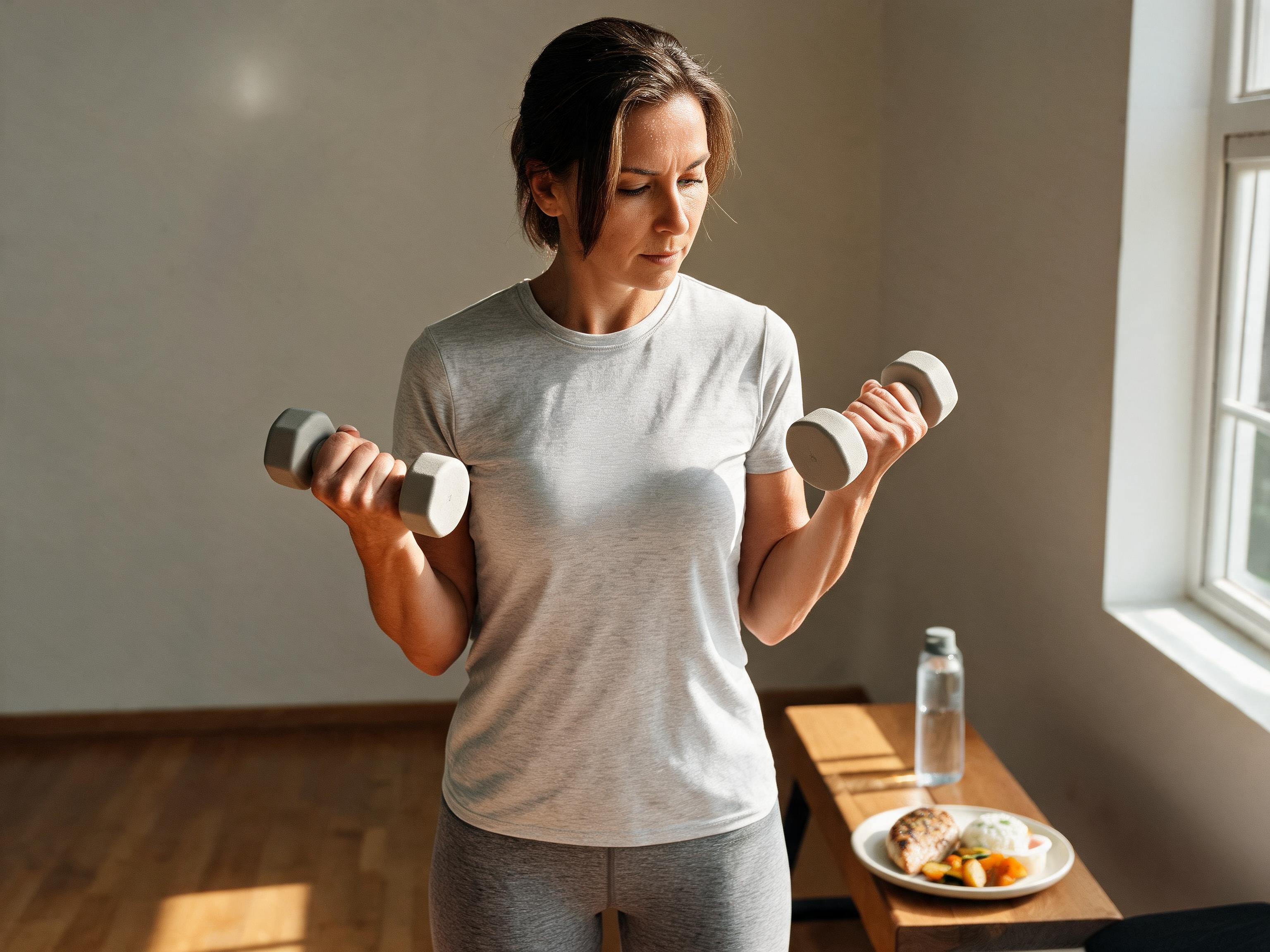
- Pair whatever protein number you land on with resistance training twice a week. The advisory's benefit shows up when protein and lifting are combined, not protein alone. This also answers the shake-vs-whole-food question people ask most: a gram of protein is 4 kcal whether it comes from a shake or a chicken thigh, so the floor math doesn't care about the source — whole foods just bring more volume and satiety per calorie, which matters more when total intake is already small.
- Recheck after any dose change. Appetite typically drops in steps rather than gradually, and any shift of roughly 100-150 kcal for a week or more is worth rerunning the percentage for. The underlying arithmetic here is about calories and grams, not the specific drug, so the same floor logic applies whether you're on semaglutide or tirzepatide.
If manually running that math every time your appetite shifts sounds tedious, that's exactly the gap our free calculators — and the AI food logging in the Kaloria app — exist to close: point the camera at your plate, get the protein-to-calorie math done for you, adjust from there.
Sources
- Nutritional priorities to support GLP-1 therapy for obesity (Mozaffarian et al., 2025)
- Stop Muscle Loss: The Urgent GLP-1 Protein Warning You Need (2026)
- Muscle Mass and Glucagon-Like Peptide-1 Receptor Agonists (Linge et al., 2024)
- Preserving Lean Body Mass in Patients Taking GLP-1 for Obesity (2025)
- Consuming more protein may protect patients taking anti-obesity drug from muscle loss (Endocrine Society, 2025)
- Dietary intake by patients taking GLP-1 and dual GIP/GLP-1 receptor agonists (Christensen et al., 2024)
- New GLP-1 Therapies Enhance Quality of Weight Loss... (American Diabetes Association, June 2025)
This article is for information only and isn't medical advice. Talk to your doctor or a registered dietitian before making significant changes to your diet, especially if you're pregnant, nursing, or managing a medical condition.